A Personal CyberMuseum:
Documents, Photo Albums, Talks, and Videotapes about Computing History
Gordon Bell timelines for an overall computer history
timeline of significant entities and events in Information Processing.
·
Timeline
of Computing History BC-2013. Computers, languages,
semiconductors, inventions and the like. This timeline consisting of 8 parallel lines
is organized around the principle functions of information processing as they
affect use. The main line is computers for people. Other lines: computers for
science and engineering, record keeping, communications and networking,
computers for control, and the control element (algorithms, architectures,
languages).
·
Please
review, add, comment, correct and return your feedback to me if you feel up to
the task.
Note on Digital Equipment
Corporation (DEC) artifacts:
- GBell's Cybermuseum
for Digital Equipment Corporation (DEC) has artifacts, books,
brochures, clippings, manuals, memos, memorabilia, photos, posters,
presentations, etc. relating to DEC.
- Family Tree of Digital's
Computers Poster created by Gordon Bell in 1980 showing the evolution
of all of all computer models and times they were introduced since 1960.
- Gordon's
Personal View of the Origins of Personal Computing from a
Digital Equipment Corporation perspective. PowerPoint presentation (4 MB,
sans video and audio clips) given at the Vintage Computer Fair, Santa
Clara, CA, 9 September 1998.
- Gordon Bell
Interview by David Allison, head of the Computing Collection at the
Smithsonian, in the Summer of 1995, with updates
and corrections in June 2000. This material covers a period of the
author's life that goes beyond Digital.
Documents of historical interest
that have been scanned
- Jay
W. Forrester response to Gordon Bell email query, May 2011 regarding
the Wang "Pulse transfer controlling devices" patent for shift
registers and the Forrester “Multicoordinate
digital information storage device" invention of Core Memory.
- Hollerith's Original Patent
Application, January 1889.
- Computer
Generations Booklet created by Gordon Bell in 1975 to accompany a
display of computing artifacts in the lobby of Building 12, Digital's
headquarters.
- Family Tree of Digital's
Computers Poster created by Gordon Bell in 1980 showing the evolution of
all of all computer models and times they were introduced since 1960.
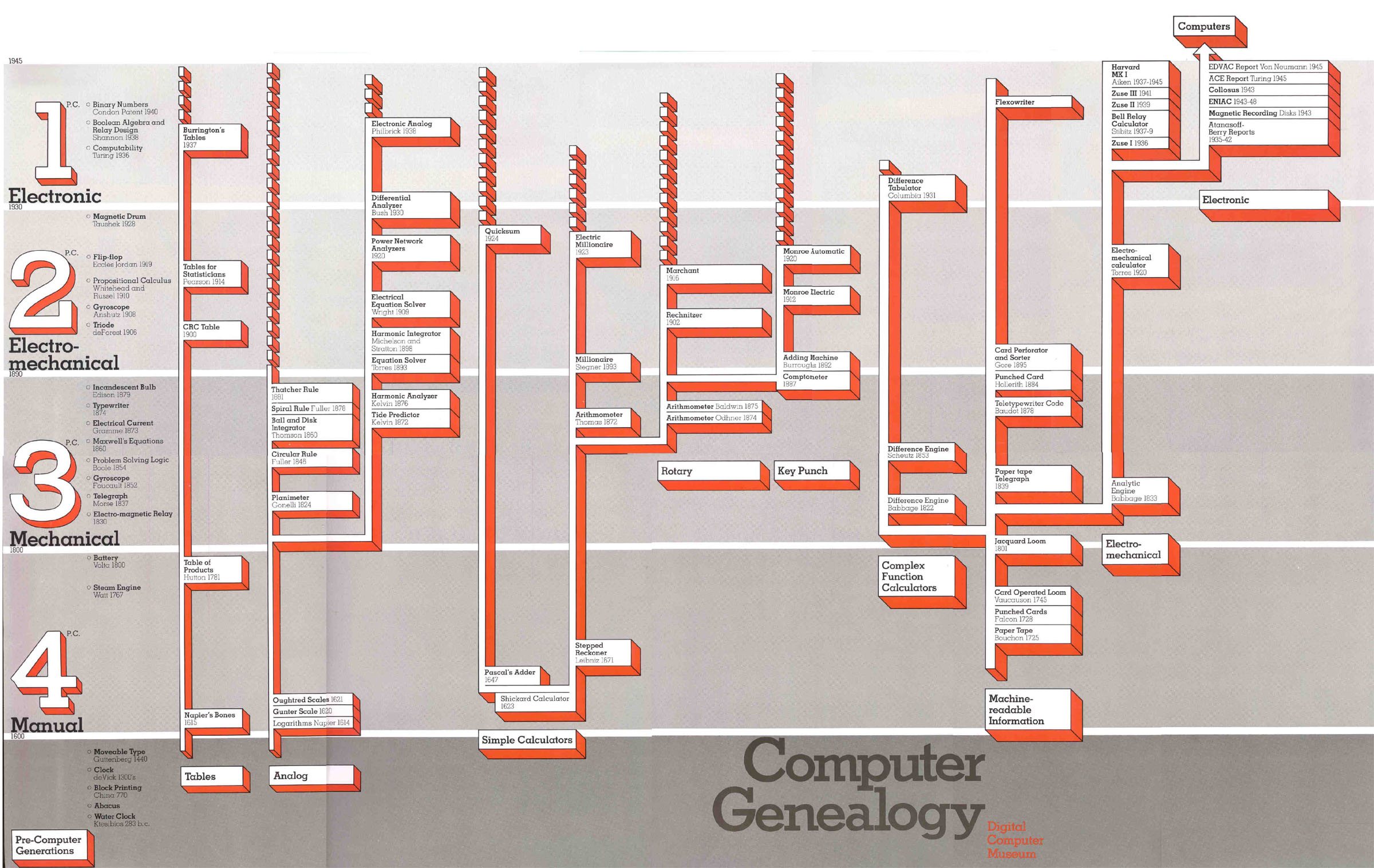
- Computer
Museum Poster of Pre-computing Generations created by Gordon Bell in
1980 showing a progression of various computing devices and technologies.
- Computer Museum Memories
Poster showing various memory and storage devices.
- Computer
Museum "Building Blocks of AI" Poster of a quilt created by
Penny Nii that has the "fathers of
AI".
- Ardent
Price
versus Performance of Supercomputers Poster in 1988.
- Ardent
"Foundations
of Supercomputing" Timeline Poster giving the timeline of
computer classes and technologies till 1988.
- Microprocessor
Poster, 25 years of Microprocessor evolution. 2.17 MB jpg.
- CDC 8600 Manual, preliminary 8600 reference
manual, Control Data Corporation.
- CDC 8600 Patent No. 3833889, dated
September 3, 1974.
- Adams Associates Computer Characteristics
Quarterly, dated 1967, scanned and contributed by Ed Thelen. This quarterly contains summaries for all
commercial computers at the time.
- IBM Reference Manual for the IBM
224 Card Punch and IBM 26 Printing Card Punch, dated October 1965, scanned
and contributed by Ed Thelen.
- Ethernet Blue Book, 5MB PDF file of
Ethernet specifications from September, 1980.
- Ethernet Blue Book, Ethernet
specifications in TIF format.
- Ethernet Seminar, Ethernet Press Seminar
held at the World Trade Center on February 10, 1982, in TIF format.
- The complete Ethernet
Announcement by Bell (Digital), Noyce (Intel),
and Liddle (Xerox) slides and script (PDF
7MB) was made in New York City on February 10, 1982 by the DIX group,
followed by announcements in Amsterdam, and London. Note Gordon's presentation states: "the network becomes the
system"... Can you recall a
similar mantra that the late, departed SUN Microsystems later
appropriated?
Digital Equipment Corporation Books
- Bell, C. G., C. Mudge,
J. McNamara, COMPUTER
ENGINEERING, Digital Press 1978. At this site.
- Bell, Grason,
Newell, DESIGNING
COMPUTERS AND DIGITAL SYSTEMS USING PDP-16 REGISTER TRANSFER MODULES,
Digital Press, September 1972. At this
site.
Papers and Reports
·
Bell, C. Gordon STARS:
The Rise and Fall of Minicomputers IEEE Global History Network, posted 22
January 2013. This paper was written with the co-operation of the IEEE GHN
editors and editorial policies e.g. format, word count. The importance of the minicomputer’s contribution
to personal computing and networking were significant-- minis pioneered apps
that became completely stand-alone industries.
The paper describes how almost 100 companies came into existence doing
this era (1965-1985) based on LSI technology, an Original Equipment
Manufacturers (OEM) tiered market structure for creating new applications in
real time control, communication switching, user interface, and smaller scale
computation and record keeping for business and word processing.
·
Bell, G. “Out of a Closet: The Early Years of The
Computer [X]* Museum”. Technical Report. MSR-TR-2011-44. This technical report was written for
Professor Brian Randell’s 75th Festschrift. The 2011
opening at the Computer History Museum of the world’s largest and most complete
physical and cyber exhibit of computing history marks the sixth stage of a
public museum’s evolution, which began in 1975 with a closet-sized exhibit in a
Digital Equipment Corporation building, migrating to The Computer Museum,
Boston. In 2011, it lives in a 119,000 square foot public home plus its artifact storage
facility. This chance/luck driven
evolution of an institution is due to the dedication and leadership of a few
people who persuaded hundreds of others that the endeavor was worthwhile and
needed their support. They would not let
it die! Behind nearly every artifact,
exhibit, and pioneering effort is a story that the museum is dedicated to
understand and tell. This is the story leading to the Computer History Museum,
Mountain View, Ca. The heroes in the story are Ken
(Olsen), Gwen (Bell) and Len (Shustek). Ken was a critical, seminal founder and
supporter from the early 1970s. Gwen was its main keeper from 1979 till 1998.
Len picked up the torch in 1994.
- The
Computer Museum Report, Winter 1983. A
Companion to the Pioneer Timeline, with talks, by their builders about the
Bell Labs Model 1 Complex Calculator; Zuse Z1
and Z3; Atanasoff-Berry, ABC; Colossus; ENIAC;
EDVAC: IAS Computers; EDSAC; Manchester Mark I; Pilot ACE; NBS SEAC and
SWAC; MIT Whirlwind.
- The
Computer Museum Reports. Annual Reports, and
First Brochure on the Computer Museum Project are contained in this PDF
file of about 100 Mbytes and covers 1975, 1980-1998 when the museum moved
to Silicon Valley as the Computer History Museum. This compendium is posted
as a reference for a number of talks by computer pioneers from Atanasoff to Zuse.
- The
Revolution Yet to Happen, ACM2047.doc (300K or about
7K words) is an invited book chapter commemorating the 50th anniversary of
the Association for Computing Machinery by Jim Gray and I. We posit the
next platforms, interfaces and networks as a framework for new kinds of
computers e.g. Do What I Say, Body Area Nets, and Guardian Angels.
- The next 50 years:
More Change Than Anyone Can Imagine is a paper
that speculates about future micros. It was published in the
Microprocessor Report, August 1996 or it can be read Future
Micros.doc (150K) .
- CyberAll has
stimulated interest in a CyberMuseum, as a part
of The Computer Museum History
Center located at Moffett Field, Mountain View, CA. (see also extended
bio regarding the museum).
- My
thoughts on the merits of a Cyberspace versus a Meatspace (Physical) Computer history Museum were
written in the Spring of 2002 as a Trustee for
the Computer history Museum using a multi-dimensional framework that
allows trustees, members, supporters, and others to understand their own
priorities in regard to the construction of such a museum.
Fundamentally, it comes down to the cost to maintain a meatspace
presence (building and exhibits) to attract large crowds and financial
support versus a more modest place that will preserve and present
artifacts to a worldwide audience using WWW, with minimal ability to
exhibit and explain artifacts.
PowerPoint Albums and Talks of
Computing History
- Laws that Govern the Computer Industry and
Computer Class formation. PowerPoint Presentation sans script. This is a
working outline of a book that Jim Gray and I have talked about writing by
perhaps 2001. We have collected a score of Laws (e.g. Moore's, Metcalfes's, Bill's, Nathan's) that describe the
computer industry and market.
- Internet 1, 2,
& 3. Past, present, and future. Talk and PowerPoint with scripts,
given April '95 InternetWorld html Talk
with script
or PowerPoint Internet.ppt (250K). This talk
gives some comments on the evolution starting with ARPAnet.
- Supercomputing
(t): A Photo Chronology
A
PowerPoint album (7.2 MB) with various supercomputer photos and
specifications, chronicling the evolution of computing starting before the
computer and continuing to 2000. Click to view the talk in
your browser.
- Predicting Future Telecom Services and
Lack Thereof Bellcore Conference (Competing in
the Millennium) 5 May 1998
- PowerPoint Presentation sans script
Talk with Bob Lucky about the future challenges for all telecom carriers
e.g. LECs, CLECs, IECs, IXCs. This includes why
phone guys hate computers guys, why computer guys hate phone guys, and why
no one likes cable guys.
- Six Challenges for Future Computing. PowerPoint
Presentation sans script. Presented at the New Paradigms for Using
Computers aka New Uses for the PC Workshop at IBM Research, Almaden, CA, on 16 July 1998. Also, given to INRIA
October 1998
- Manchester University 50th Anniversary Keynote PowerPoint
Presentation sans script. This conference celebrated the 50th anniversary,
21 June 1948, of the first stored program operation at Manchester University on their
"Baby" computer. My talk recalls the various contributions to
computing at Manchester, including the discovery of virtual memory, memory
hierarchies, and the one-level store.
- Gordon's Personal
View of the Origins of Personal Computing from a
Digital Equipment Corporation perspecive.
PowerPoint presentation (4 MB, sans video and audio clips) given at the
Vintage Computer Fair, Santa Clara, CA, 9 September 1998.
Gordon Bell Perspectives and Memoirs
on Significant Computer Pioneers
Netshow Videos and Videotapes
- A short (5 min.) video on the Life of
Seymour Cray is provided by Cray Research/SGI at 28.8Kbps and 300Kbps.
- Computer Pioneers (Atanasoff,
Grosch, Hopper, Stibitz
and Zuse) and Pioneer Computers Videotapes
(ENIAC to EDVAC, with Burks, Eckert, Mauchly,
and Wilkes) are two 50 minute videotapes using original film and video
that The ACM, The Computer Museum, and Gwen Bell and I produced. They are
available from the ACM and The
Computer Museum.
- The Laws of Prediction. Netshow Talk given at the ACM97 Conference, San Jose,
CA, March 3-5, 1997. All of the ACM97 Talks are at http://research.microsoft.com/acm97.
- On the Future
of Computers.
Netshow Video @28.8 Kbps. This 1972 videotaped
lecture was given at M.I.T. and describes a model for future computers,
including computer classes and the prediction of new types of computers.
- History
of Supercomputers PowerPoint talk and one hour Video of the
talk was given at Lawrence Livermore National Laboratory on 24 April, 2013
.wmv . Abstract: Since my first visit to Livermore in 1961 and seeing
the LARC, recalling the elegance of the 6600, and just observing this
computer class evolution have been high points of my life as an engineer
and computing observer. Throughout their early evolution, supercomputer
architecture “trickled down” in various ways for use with other computers.
In the mid 1990s the flow reversed when large
computers became scalable and constructed from clusters of microprocessors.
Unlike the two paths of Bell’s Law that account for the birth, evolution,
and death of other computer classes e.g. minicomputers, http://ieeeghn.org/wiki/index.php/STARS:Rise_and_Fall_of_Minicomputers
supercomputers have doubled in performance every year for the last 50
years just by building larger structures. While computer performance is
the first order term to track their high performance, many other
technologies e.g. FORTRAN, LINPACK, government funding policy, and
applications have contributed to the extraordinary progress. This
talk traces a trajectory and contributors to the history of supercomputers
class.
Gordon Bell Biographical Material
including Interviews, etc.
Gwen and Gordon Bell Artifacts
Collection
- Computing
Artifacts. Over 300 computing artifacts collected by Gwen and Gordon
Bell.
- Book Collection.
Collection of rare and historical books collected by Gwen and Gordon Bell.
Books
These
books were encoded at Carnegie-Mellon University and hosted at their Universal
Library http://www.ulib.org/ . With the exception
of High Tech Ventures, the books are out of print and unavailable.
- Bell C. G., A. Newell, COMPUTER
STRUCTURES: READINGS AND EXAMPLES, McGraw-Hill, 1971. At this site.
- Bell, Grason,
Newell, DESIGNING
COMPUTERS AND DIGITAL SYSTEMS USING PDP-16 REGISTER TRANSFER MODULES,
Digital Press, September 1972. At this
site.
- Bell, C. G., C. Mudge,
J. McNamara, COMPUTER
ENGINEERING, Digital Press 1978. At this site.
- Siewiorek, D., C. G. Bell, A. Newell, COMPUTER
STRUCTURES: PRINCIPLES AND EXAMPLES, McGraw-Hill, 1982.
- Bell, C. Gordon, John E. McNamara, HIGH TECH VENTURES: THE GUIDE TO
ENTREPRENEURIAL SUCCESS, Addison-Wesley, 1991. At this site.
This book is available in hard copy from Addison-Wesley. It is put
here for viewing and not for downloading and printing to circumvent the
purchase of a book. Hard copies should be purchased from the
publisher.
msr home
| search | Microsoft