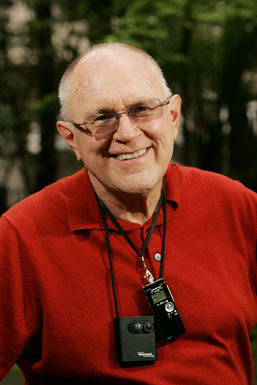
Gordon Bell
Microsoft Research Silicon Valley
Email: GBell At
Outlook Dot com
Phone: (415) 640 8255
Gordon Bell is a researcher emeritus (ret.) at
the Microsoft Research Silicon Valley Laboratory. His interests include extreme
lifelogging, digital lives, preserving everything in cyberspace, and cloud
computing as a new computer class and platform aka Bell’s Law. He proselytizes
Jim Gray’s Fourth Paradigm of Science.
Gordon has long
evangelized scalable systems starting with his interest in multiprocessors (mP) beginning in 1965 with the design of Digital's PDP-6,
PDP-10's antecedent, one of the first mPs and the
first timesharing computer. He continues
this interest with various talks about trends in future supercomputing (see Papers… presentations, etc.)
When joining Microsoft in
1995, Gordon had started focusing on the use of computers and the necessity of telepresence:
being there without really being there, then. "There" can be a
different place, right now, or a compressed and different time (a presentation
or recording of an earlier event). In 1999 this project was extended to include
multimedia in the home (visit Papers… presentations, etc.).
He puts nearly all of his
atom- and electron-based bits in his local Cyberspace—the MyLifeBits project
c1998-2007. This includes everything he
has accumulated, written, photographed, presented, and owns (e.g. CDs).
Jim Gemmell and I have
written a book entitled Total Recall: How the e-Memory Revolution Will Change
Everything which was published in September 2009. See Amazon,
Barnes
& Noble, Borders,
or IndieBound.
Your
Life, Uploaded: The Digital Way to Better Memory, Health, and Productivity is the paperback version published
September 2010. It is available in Dutch, French, Italian, Japanese, Korean,
and Portuguese. Also check out the Total Recall book website.
The remainder of the site
includes these pages:
- Papers, books,
PowerPoint presentations, videos since 1995, at Microsoft
- Extended Bio-- education, work history,
honors... Alaska fishing, France biking
- Books,
computers, interviews, papers, patents, projects, and videos
- Supercomputing and the CyberInfrastructure articles, memos, talks, and
testimony regarding high performance computing e.g. funding, goals, and
problems in reaching to the Teraflops in 1995 and Petaflops in 2010.
- THE
COMPUTER MUSEUM ARCHIVE An
archive of The Computer Museum in Boston 1980-1998. In 1995, TCM’s
artifacts formed the basis of the Computer
History Museum, Mountain View, CA. The official site of The
Computer Museum Archive is tcm.computerhistory.org.
6. The timeline of the
history of The Computer Museum gives the critical events in the life of TCM
with exhibits, lectures, reports, publications, etc.
- Gordon's
Cyber Museum that has Bell's books, the Hollerith Patent, the CDC 8600
Manual, a talk about Seymour Cray, an album of supercomputer photos,
posters about the history of computing, etc.
- Gordon
Bell's Digital Equipment Corporation (DEC) Cyber
Museum artifacts, books, brochures, clippings, manuals, memos (e.g.
The VAX Strategy), memorabilia, photos, posters, presentations, etc.
relating to Digital Equipment Corporation a.k.a. DEC.
9. The Timeline of
Computer History BC to the present.
Gordon Bell’s view of the important events that formed the computing age
in 10 event lines: Epoch Inventions, Control Technology, Control Computers, Calculators,
Personal Computers, Transduction aka interfaces, Business and Record Keeping
computers, AI, Communications, Publications-ideas, and Companies.
The Computer History
Timeline, BC to the present. Gordon
Bell view.
10. Supercomputing 2014, 18 November
Seymour Cray Award acceptance talk. This PowerPoint talk on the history of supercomputing
covers the period 1960 to the present with two distinct eras: mono-memory
computers that Seymour Cray defined 1963-1993; and Multicomputers or Clusters
1984-present. YouTube talk access of
the video .
11. Bell’s Law of Computer
Classes (first draft) YouTube PowerPoint presentation with Gordon Bell’s
voiced comments about the dozen computer classes and industries 1951-2015.
12. The Laws and Folly of
Prediction. YouTube talk at the 1997 ACM 50th Anniversary
Conference, San Jose--3 years before the 2000 internet bubble; and 2007 rise of
smartphones. While my ability to predict
is stuck at a maximum of 10 years, the long term accuracy is correct --
Everything will be in Cyberspace e.g. the Body Area Network c2014. Laws of
prediction are cited along with example gone awry predictions.
13. Gordon
Bell The Future of Computers MIT 1972.
This YouTube videotaped talk demonstrates my limited abiliYou
ty to predict in 1972 as VP of R&D at Digital Equipment Corporation (DEC).
I had returned from being on Carnegie Mellon University faculty with the goal
of getting DEC into VLSI technology. Recall the first commercial microprocessor
had just been introduced a year earlier.
This talk is about where computing was headed that I could see in 1972.
14. Counting Every Heart
Beat: Observation of a Quantified Selfie MSR-TR-2015-53. View graphs from the TR of Bell heart rate,
etc. Here.
Bell's Law of Computer Classes and Class
formation
October 24 YouTube Talk
(50 min lecture for Computer History classes)was first described
in 1972 with the
emergence of a new, lower priced microcomputer class based on the
microprocessor. Microsoft Technical
Report MSR-TR-2007-146 describes the law and gives the implication for
multiple cores per chip, etc. Established market class computers are introduced
at a constant price with increasing functionality (or performance). Technology
advances in semiconductors, storage, interfaces and networks enable a new
computer class (platform) to form about every decade to serve a new need.
Each new usually lower priced class is maintained as a quasi
independent industry (market). Classes include: mainframes (60's),
minicomputers (70's), networked workstations and personal computers (80's),
browser-web-server structure (90's), web services (2000's), palm computing
(1995), convergence of cell phones and computers (2003), and Wireless Sensor
Networks aka motes (2004). Beginning in the 1990s, a single class of scalable
computers called clusters built from a few to tens of thousands of commodity
microcomputer-storage-networked bricks began to cover and replace mainframes,
minis, and workstation. Bell predicts home and body area networks will form by
2010. See also the description of several laws (e.g. Moore's, Metcalfe's,
Bill's, Nathan's, Bell's) that govern the computer industry is given in Laws, a
talk by Jim Gray and Gordon Bell.
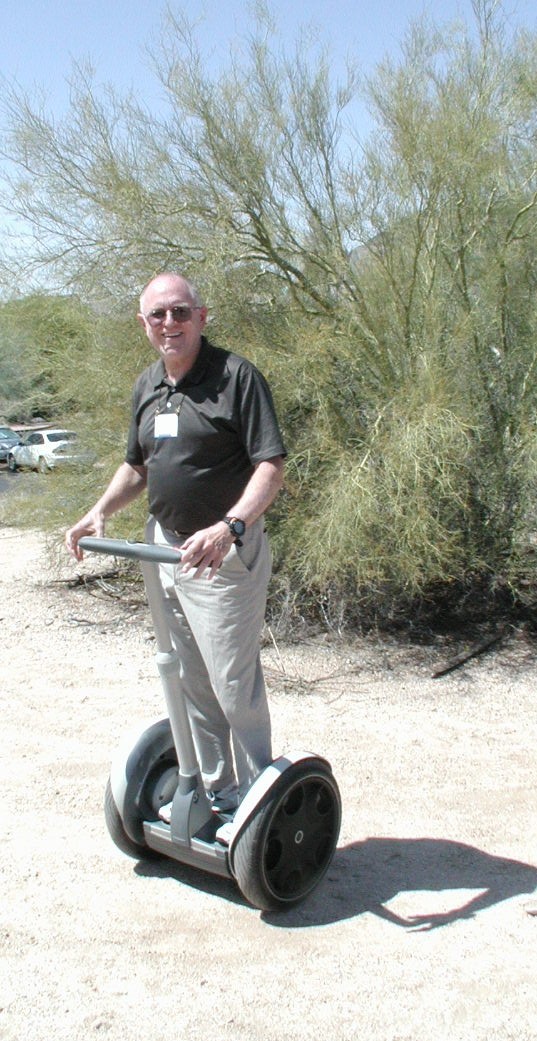
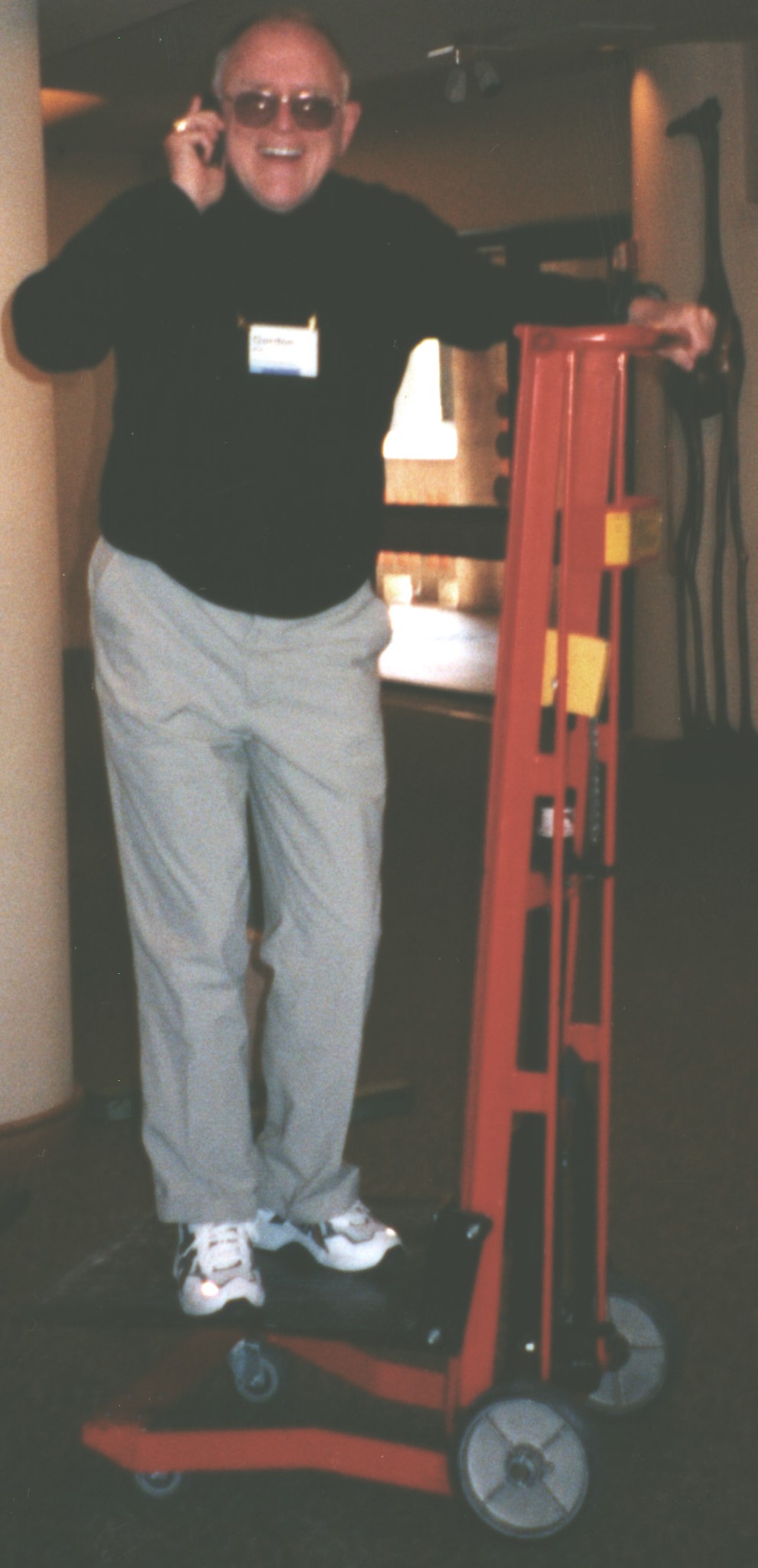 Gordon was with his Diamond Exchange colleagues at the
Boulders, Carefree, AZ where the group tested the Segway, a dual-processor, two
wheeled, computer and Human Transporter. Since the test in 2002, he has
taken and recommended tours in the Pacificia near San
Francisco, and Washington, DC. Right is the SUV version.
Gordon was with his Diamond Exchange colleagues at the
Boulders, Carefree, AZ where the group tested the Segway, a dual-processor, two
wheeled, computer and Human Transporter. Since the test in 2002, he has
taken and recommended tours in the Pacificia near San
Francisco, and Washington, DC. Right is the SUV version.