|
|
Gina
Venolia
|
|
|
MSR |
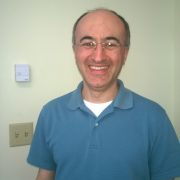
I am
a user interface architect with Microsoft Research in the Human Interactions of Programming
team. My research focuses on understanding how knowledge flows among
people and building systems to make it flow more freely.
Current Research
I am currently studying co-located and geographically distributed software development teams, building tools that help developers find and communicate about the knowledge behind the code, and developing systems that exploit spatial memory to support navigation, team awareness, and communication about code.
Software Development User Research (2005-present) - The Human Interactions of Programming team applies human-centered research techniques to build tools that improve the software development process. As a human-centered effort, we draw from various research fields including human-computer interaction, information visualization, computer-supported cooperative work, and social computing. The central tenet of these fields is that one needs to understand the user's needs in order to design tools to support them. We are using a variety of user research techniques to understand our users.
Bridges Between Silos (2004-present) - Software development is characterized by data "silos" - the databases that hold all the information but have virtually no connection between them. I am working on pulling the silos together in a common index that represents not just objects but relationships between them. Relationships come in a variety of forms, from structured references within the silo schemas to human-readable textual allusions. By pulling these together into a common representation and then using the resulting graph to improve search, I hope to transform turn the data that's today locked away in silos into working knowledge.
Past Research
Blogs (2004-2005) - I became interested in blogs and how they move information around in new ways. Jonathan Grudin and I are midway through a longitudinal study of blog awareness, attitudes, and adoption.
Grand Central (2002-03) - As I pursued my interests in person-centric computing, it became clear that the user experience for email does not meet the user needs. I set out to design a new email client around people and conversations. For more information see:
Sideshow (2001) - A key part of person-centric computing is being able to be aware of a handful of important people. We generalized this notion into a sidebar composed of little thumbnails, each representing an interesting subject: a person, the next meeting on your calendar, your portfolio, etc. Sideshow has become the Longhorn Sidebar. For more information see:
Virtual Kitchen (2000) - I did the user interface design for a
project that attempted to foster informal communication between researchers by
providing an open three-way videoconference. For more information see
MiPad (1999) - In the Speech group I designed the MiPad prototype, which used speech and pen together in a novel way to control a handheld computer for commands and dictation. For more information see: · MSR article: Your pad or
MiPad (1999) · Press release: Microsoft MiPad Press Pass · Red Herring: Inside Microsoft · Financial Times: Microsoft
taps the market for voice-operated portables I've been in three groups at Microsoft Research. I started in the Speech Technology Group in September 1998, moved to the Collaboration and Multimedia Group in February 2000, and joined Adaptive Systems and Interaction Group in October 2001.
|
|
|
Cosmo |
Before joining Microsoft, I was at Cosmo Software, a now-defunct division of Silicon Graphics. My main contribution there was the user interface design for Cosmo PageFX, a novel tool for developing animated elements for web pages using VRML. PageFX had a very cool visual language for describing the causal chain of events and animation effects.
|
|
|
Apple |
Before that, I was at Apple Computer for 15 years. Most of my time there was spent in the Advanced Technology Group. I shipped a number of things, including the QuickDraw 3D User Interface Guidelines and Toolbox, the Apple Game Sprockets APIs, mouse acceleration (twice!) and LisaTerminal.
|
|
|
Me |
I am a California native, and enjoy hiking, kites, tennis and fashion. I'm learning to play piano. I live in the 'burbs of Seattle with my partner, our 13 year old son and our two miniature dachshunds (another pic) and our monstrous Boston Terrier. I love the color fuchsia.
|
|
|
Papers |
Venolia,
G., Morris, M. R., and Morris, D. Exploring
and investigating: Supporting high-level search activities. MSR Tech
Report MSR-TR-2007-05.
January 2007. DeLine,
R., M. Czerwinski, B. Meyers, G. Venolia, S. Drucker, and G. Robertson. Code
Thumbnails: Using Spatial Memory to Navigate Source Code. To appear in Proc.
VL/HCC 2006 [link]. LaToza, T., G. Venolia, and R. DeLine. Maintaining Mental Models: A Study of Developer Work Habits. In Proc. ICSE 2006 (ACM Digital Library). May 2006. Venolia, G. Textual Allusions to Artifacts in Software-related Repositories. In Proc. Mining Software Repositories 2006 (ACM Digital Library). Also available as MSR Tech Report MSR-TR-2006-73. May 2006. Venolia, G. Ligature: Combining Node-and-link Graph Rendering with a Timeline for Sensemaking in Software Development Repositories. MSR Tech Report MSR-TR-2006-75. April 2006. Venolia, G., DeLine, R., and LaToza, T. Software Development at Microsoft Observed: It's about people ... working together. MSR Tech Report MSR-TR-2005-140. October 2005. Venolia, G. and C. Neustaedter. Understanding sequence and reply relationships within email conversations: A mixed-model visualization. In Proc. CHI 2003 (ACM Digital Library). Also available as MSR Tech Report MSR-TR-2002-102. Dabbish, L., G. Venolia, and JJ Cadiz. Marked for deletion: An analysis of email data. In Proc. CHI 2003 Extended Abstracts (ACM Digital Library). Cadiz, JJ, G. Venolia, G. Jancke, and A. Gupta. Designing and deploying an information awareness interface. In Proc. CSCW 2002 (ACM Digital Library). Also available as MSR Tech Report MSR-TR-2002-87. Goodman, J., G. Venolia, K. Steury, and C. Parker. Language modeling for soft keyboards. In Proc. ICASSP 2002 (IEEE). Also available as MSR Tech Report MSR-TR-2001-118. Goodman, J., G. Venolia, K. Steury, and C. Parker. Language modeling for soft keyboards (short paper). In Proc. IUI 2002 (ACM Digital Library). Venolia, G., L. Dabbish, JJ Cadiz, and A. Gupta. Supporting email workflow. MSR Tech Report MSR-TR-2001-88. X. Huang, A. Acero, C. Chelba, L. Deng, J. Droppo, D. Duchene, J. Goodman, H. Hon, D. Jacoby, L. Jiang, R. Loynd, M. Mahajan, P. Mau, S. Meredith, S. Mughal, S. Neto, M. Plumpe, K. Stery,. G. Venolia, K. Wang, and Y. Wang. MiPad: A multimodal interaction prototype. In Proc. ICASSP 2001 (IEEE). Also available here. Jancke, G., G. Venolia, J. Grudin, JJ Cadiz, and A. Gupta. Linking public spaces: Technical and social issues. In Proc. CHI 2001 (ACM Digital Library). Also available as MSR Tech Report MSR-TR-2000-93. G. Venolia and F. Neiberg. T-Cube: A fast, self-disclosing pen-based alphabet. In Proc. CHI 1994 (ACM Digital Library) G. Venolia. Facile 3D direct manipulation. In Proc. INTERCHI '93 (ACM Digital Library) G. Venolia. and L. Williams. Virtual integral holography. In Proc. SPIE Electronic Imaging 1990. |