|
|

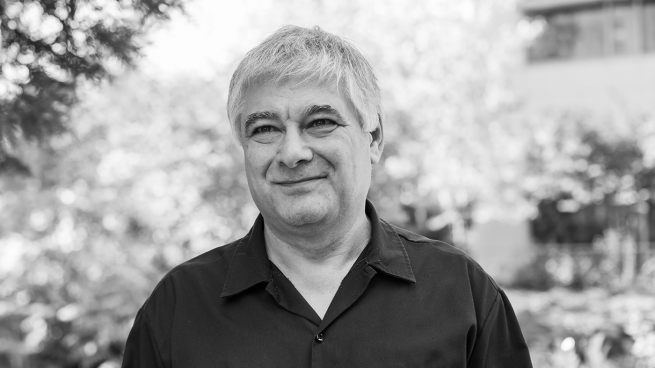
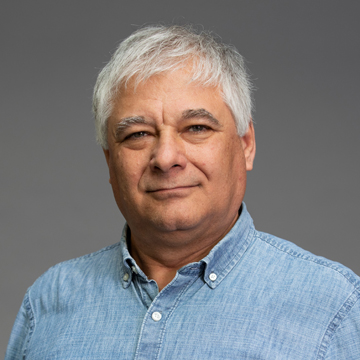
Ivan
Tashev
Principal Architect
Speech Technology Group
- Multichannel audio signals processing
- Algorithms for arrays of transducers (microphones, speakers,
antennas)
- Processing of signals for enhancement, de-noising,
de-reverberation, etc.
- Statistical processing of audio, biological, radio signals
Education
Career
- Microsoft Corporation,
Redmond, USA: various positions in COM+ and Application Center
teams, 1998-2001. Joined
Microsoft Research in 2001.
- Technical University of Sofia, Bulgaria: Assistant Professor,
1989-1998, Faculty of Electronic Engineering and Technology
(lectures and labs for "Data and Signal Processing" and "Real time
systems programming").
- Technical University of Sofia, Bulgaria: Researcher, 1986-1989,
Research and
Development Department
- Technical University of Sofia, Bulgaria: R&D engineer,
1984-1986, Research
and Development Department
Resume
Click here
More than 50 publications, 30 patents (issued and pending), one book and two book chapters.
For the full list
click here.
Recent Publications
- Ivan Tashev, Jasha Droppo, Michael Seltzer, Alex Acero. “Robust
Design of Wideband Loudspeaker Arrays”. International Conference on
Audio, Speech and Signal Processing ICASSP 2008, Las Vegas, USA,
April 2008. [PDF]
- Nilesh Madhu, Ivan Tashev, Alex Acero. “An EM-based
Probabilistic Approach for Acoustic Echo Suppression”. International Conference on
Audio, Speech and Signal Processing ICASSP 2008, Las Vegas, USA,
April 2008. [PDF]
- Ivan Tashev, Michael L. Seltzer, Yun-Cheng Ju, Dong Yu, Alex
Acero. "Commute UX: Telephone Dialog System for Location-based
Services". Proceedings of SIGdial Workshop on Disclosure and
Dialogue 2007, Antwerp, Belgium, September 2007. [PDF]
- Michael L. Seltzer, Yun-Cheng Ju, Ivan Tashev, Alex Acero.
"Robust Location Understanding in Spoken Dialog Systems Using
Intersections". Proceedings of Interspeech 2007, Antwerp, Belgium,
August 2007. [PDF]
- Ivan Tashev, Henrique Malvar. “Stationary-tones Interference
Cancellation Using Adaptive Tracking”. International Conference on
Audio, Speech and Signal Processing ICASSP 2007, Honolulu, USA,
April 2007. [PDF]
- Byung-Jun Yoon, Ivan Tashev, Alex Acero. “Robust Adaptive
Beamforming Algorithm Using Instantaneous Direction of Arrival with
Enhanced Noise Suppression Capability”. International Conference on
Audio, Speech and Signal Processing ICASSP 2007, Honolulu, USA,
April 2007. [PDF]
- Michael L. Seltzer, Ivan Tashev, Alex Acero. “Microphone Array
Post-Filter Using Incremental Bayes Learning to Track the Spatial
Distribution of Speech and Noise”. International Conference on
Audio, Speech and Signal Processing ICASSP 2007, Honolulu, USA,
April 2007. [PDF]
- Ivan Tashev, Alex Acero. Microphone Array Post-Processor Using
Instantaneous Direction of Arrival. International Workshop on
Acoustic, Echo and Noise Control IWAENC 2006, Paris, France,
September 2006. [PDF]
- Yong Rui, Eric Rudolph, Li-wei He, Rico Malvar, Michael Cohen,
Ivan Tashev. PING: A Group-to-Individual Distributed Meeting System.
International Conference Multimedia and Expo ICME’06, Toronto,
Ontario, Canada, July 2006. [PDF]
- Ivan Tashev, Jasha Droppo, Alex Acero. Suppression Rule for
Speech Recognition Friendly Noise Suppressors. Eight International
Conference Digital Signal Processing and Applications DSPA’06,
Moscow, Russia, March 2006. [PDF]
- Zicheng Liu, Michael Seltzer, Alex Acero, Ivan Tashev, Zhengyou
Zhang, Mike Sinclair. "A Compact Multi-Sensor Headset for Hands-Free
Communication". Workshop on Applications of Signal Processing to
Audio and Acoustics, New Paltz, NY, USA, October 2005. [PDF]
- Ivan Tashev. "Beamformer Sensitivity to Microphone Manufacturing
Tolerances". Nineteenth International Conference Systems for
Automation of Engineering and Research SAER 2005, St. Konstantin
Resort, Bulgaria, September 2005. [PDF]
- Ivan Tashev, Michael Seltzer, Alex Acero. "Microphone Array for
Headset with Spatial Noise Suppressor". Proceedings of Ninth
International Workshop on Acoustic, Echo and Noise Control IWAENC
2005, Eindhoven, The Netherlands, September 2005. [PDF]
- Ivan Tashev, Henrique S. Malvar. "A new beamformer design
algorithm for microphone arrays". Proceedings of International
Conference of Acoustic, Speech and Signal Processing ICASSP 2005,
Philadelphia, PA, USA, March 2005. [PDF]
- Ivan Tashev, Daniel Allred. "Reverberation reduction for improved
speech recognition". Proceedings of Hands-Free Communication and
Microphone Arrays, Piscataway, NJ, USA, March 2005. [PDF]
- Ivan Tashev. "Gain Self-Calibration Procedure for Microphone
Arrays". Proceedings of International Conference for Multimedia and
Expo ICME 2004, Taipei, Taiwan, June 2004. [PDF]
- Ivan Tashev. "Improving Meetings with Microphone Array
Algorithms". Machine Learning Meets the User Interface Workshop,
Neural Information Processing Systems NIPS 2003, Whistler, Canada,
December 2003. [PDF]
- Ross Cutler, Yong Rui, Anoop Gupta, JJ Cadiz, Ivan Tashev,
Li-wei He, Alex Colburn, Zhengyou Zhang, Zicheng Liu, Steve
Silverberg. “Distributed Meetings: A Meeting Capture and
Broadcasting System”. Proceedings of ACM Multimedia 2002, Nice,
France, December 2002. [PDF]
Selected Presentations
- "Commute UX: Telephone Dialog System for Location-based
Services". Presentation during SIGdial Workshop on Disclosure and
Dialogue 2007, Antwerp, Belgium, September 2007. [PDF]
- "Defeating Ambient Noise: Practical Approaches for Noise
Reduction and Suppression". Tutorial during IEEE International
Conference of Acoustic, Speech and Signal Processing ICASSP 2006,
Toulouse, France, May 2006. [Slides,
References]
- "Microphone Array for
Headset with Spatial Noise Suppressor". Presentation during Ninth
International Workshop on Acoustic, Echo and Noise Control IWAENC
2005, Eindhoven, The Netherlands, September 2005. [PDF]
- "Microphone Array Support in Windows Longhorn". Presentation
during Windows Hardware Experience Conference WinHEC 2005, Seattle,
USA, May 2005. The same talk given during WinHEC 2005, Taipei,
Taiwan, June 2005. [PDF]
- "Microphone Array Project in Microsoft Research: Approach and
Results". Presentation in National Taiwan University and Academia
Sinica, July 2004, Taipei, Taiwan. [PDF]
- "Improving Meetings with Microphone Array
Algorithms". Presentation during Machine Learning Meets the User Interface Workshop,
Neural Information Processing Systems NIPS 2003, Whistler, Canada,
December 2003. [PDF]
- "Application Center 2000 Interoperability and
Reliability". Presentation during Application Center 2000 Airlift,
Redmond, USA, May 2001. [PDF]
Senior Member of IEEE and member of AES. Served as member of the Technical Program
Committee of ICME 2002 and
ICME 2003,
session chair in
ICME 2003. Co-founder in 1986 and organizational secretary for 12 years of
the International Conference Systems for Automation of Engineering and
Research (SAER),
now serving as member of the International Organizing Committee. Member
of the TC of International Workshop on Acoustics, Echo and Noise Control
(IWAENC) since 2006. Member of the TC of Workshop on Applications of
Signal Processing to Audio and Acoustics (WASPAA) since 2006.
Here are some of the projects I enjoyed during my career in no
particular order.
Microphone Array Project
Providing a hands free sound capture in modern computers for the
needs of real-time communication and speech recognition (voice commands
and dictation) is a technologically difficult and challenging task.
Designing a real-time microphone array processing algorithm for optimal
noise suppression, besides being a interesting research problem,
provides additional challenges when the time comes for productizing of
the software and hardware. After building the first prototypes of USB
linear four element array for office use
and circular eight element array for
the center of the conference room table started the difficult transition
from "microphone array algorithms" to "algorithms for
manufactureable
microphone arrays". The whole process includes working with product
teams inside Microsoft and evangelization of this technology to laptop, tablet and computer
monitor manufacturers outside Microsoft by publishing
white papers and giving talks. The project is in very advanced
phase for shipping as integrated in Windows Vista
microphone array support. Article about the project is posted
here,
a video containing interview with Rico Malvar talking about the project
can be found
here. More details can be found on the
Microphone Array Project web
page.
Control system for Universal Laser Ranging System ULIS-630
In the pre-GPS era the way to measure precisely the geographical
coordinates of given point was by watching satellites and measure the
distance to them using laser ranging systems. Universal Laser Ranging
System ULIS-630 was a large international project with participation of
research and academic organizations from Eastern Europe (Academy of
Sciences of the ex-Soviet Union in Moscow, Lithuanian Technical
University in Riga, Bulgarian Academy of Sciences in Sofia, Moscow
Electro-technical Institute, Technical University of Sofia, others). The
optical system is with so called horizontal
mount and consists of two paired telescopes: transmitting (Galileo
type, focal length of 12 meters, green laser with 1 J energy of the 1ns long pulse)
and receiving (Cassegrain type, 630 mm main mirror diameter, 11.5 meters
focal length and photo-multiplier tube as receiver). It is controlled by
a distributed computer system for tracking the visible trajectory of the
satellite, firing the laser, collecting and processing the results. My
work here become the core of my Ph.D. thesis.
The system itself, besides everything
else, offered decent view of planets and celestial objects (see picture
of Jupiter here)
Application Center 2000 Pre-Flight Checks
Microsoft Application Center is a web and component clusters
management software. Targeting middle range web sites it offers set of
innovative features. The
"Application Center 2000 Pre-Flight Checks" was designed to improve
out-of-the-box experience of the IT personnel, but become the unofficial
tutorial of the product. I enjoyed finding the easiest way to
demonstrate the product features with minimum additional software. Parts
of this document were used in the
Application Center Resource Kit.
Distributed Meetings System
This was my first project in Microsoft Research. It was a big,
complex system for meetings capture and recording. The capturing devices
were 360 degrees RingCam, eight element circular microphone array,
overview camera, whiteboard camera, etc. The project combined
technologies, designed in the Collaboration, Communication and
Multimedia Team and included deployment of ten of these systems in
various conference rooms in Microsoft to study the users behavior and
to get some feedback. See our
ACM paper for more
details.
Dereverberation Project
The project started with simple goal to reduce the word error rate
for speech recognition purposes for distances of up to 1.5 meters. This
was the summer project of my intern Daniel Allred, Ph.D. student in
GeorgiaTech. During his the second internship in Microsoft Research the
project was extended and re-scoped to cover some perceptual scenarios as
well. More details can be found on
Dereverberation Project web
page.
Speaker Array Project
This is pure research project for now. With my colleagues
Jasha Droppo and
Mike Seltzer, we
decided to see what can be reused from our experience in beamforming
design for microphone arrays. The loudspeaker array consists of sixteen
inexpensive speakers and has linear geometry. The project was
demonstrated during
Microsoft Research TechFest 2007 as "Personal Audio Space" and
definitely had the "Wow!" effect among the visitors in our booth. We
demonstrated focusing the sound in given area and dual beam mode when
you hear one music channel in one place and a second music channel in
another. The attending journalists liked the demo and it was widely
published in the press:
WIRED Blog Network,
Seattle PI,
MIT Technology
Review,
MSR web site, many others, in different languages and from different
countries. Currently we are exploring various
scenarios and potential
applications for this technology.
E-mail: ivantash--at--microsoft--dot--com
Postal Mail: Microsoft Corporation, One Microsoft Way, Redmond WA,
98052-6399, USA
Tel: (425) 706-1667
Fax: (425) 936-7329 (This is the main MS FAX number so make sure to send
documents to my attention)
|
Last updated: April 6, 2008