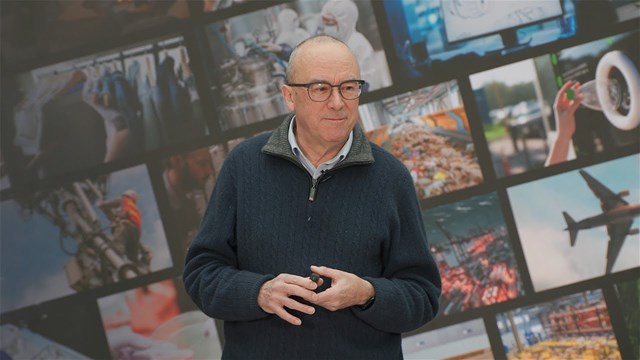
Whether it be teens, Ph.D. candidates, or new faculty, Microsoft Research Cambridge is committed to supporting European students demonstrating the potential to make a significant contribution to science, and that commitment was underscored Dec. 4-5.
Through a pair of events, the Cambridge lab confirmed its interest in fostering and cultivating the study of computer science and students working at the intersection of computing and the sciences.
On Dec. 4, the lab, in collaboration with the University of Cambridge Computer Laboratory, hosted 250 students from 19 schools for a day of talks, demos, and interactive sessions—with the theme of Think Computer Science!—designed to provide insight into the world of a computer scientist and attract more children and young adults to computer science.
The following day, 26 recipients of Ph.D. scholarships and early-career fellowships from Microsoft Research were invited to Cambridge to hear and mingle with a collection of researchers from the lab.
“One of our goals is to inspire and educate the scientists of tomorrow,” said Andrew Herbert, managing director of Microsoft Research Cambridge. “Through events such as the Think Computer Science! Lectures, in partnership with the University of Cambridge, and the European Ph.D. scholarships and fellowships that we’re announcing to support the top students and scientists in Europe, we aim to help fuel future discovery and ensure that Europe continues its heritage of scientific and technological innovation.”
The A-level students invited to the Dec. 4 event spent a full day hearing about the exciting possibilities available to those who pursue studies in computer science. Speakers from Microsoft and the University of Cambridge Computer Laboratory offered insights into a wealth of topics:
In addition, students from eight schools participated in a poster exhibition with the theme of the Computer of the Future. The winning school, Aylesbury Grammar School, was awarded a prize of £1,000.

During a lunch break, students were able to witness five tech demos:
The event concluded with a question-and-answer session with a panel consisting of the day’s presenters.
“Our aim with the Think Computer Science ! Lectures ,” Herbert said, “ is to show younger students that computer science goes beyond learning how to use spreadsheets and word processors, and that , through computer science , they can impact the role that the computers of tomorrow have on our quality of life. We shared with them our vision of what it means to do computer science — which involves everything from sociology to mobile devices—and we tried to open their eyes to the broad range of very interesting aspects involved in computer science.”
On Dec. 5, Ph.D. scholars and faculty fellows enjoyed an opportunity to mix with researchers and their peers, hailing from nations including Austria, Germany, Greece, the Netherlands, Portugal, Serbia, Spain, Sweden, and the United Kingdom.
Each year, students accepted by a European university for Ph.D. study are eligible to apply to the European Ph.D. Scholarship Programme. As many as 25 awards will be made in 2007, with each recipient awarded as much as €100,000 over three years. Each recipient also receives a laptop and pertinent software. At present, 56 students are sponsored through the programme, and the total investment by Microsoft Research is more than €1.7 million per year.
The programme is part of Microsoft’s European Science Initiative, which is focused on enabling and accelerating new kinds of science and computing, areas with the potential to create profound social, technological, scientific, and economic change.
Included in the initiative is the Fellowship Programme for Early-Career Scientists, in which as many as five highly promising post-doctoral scientists who are establishing a track record of world-leading research in science and technology receive support of as much as €250,000.
“Supporting the development of Europe’s intellectual capital is critical to ensuring that the region stays competitive in the global scientific community, as it has done throughout history,” said Fabien Petitcolas, head of Intellectual Capital Development at Microsoft Research Cambridge. “Microsoft is enabling this by partnering with the academic community and providing support for more than 100 of Europe’s brightest scholars and scientists through our Ph.D. scholarships, our fellowship programme, and calls for proposals.”
The 2006 European Ph.D. Scholarship Programme recipients:
The 2005 European Fellowship Programme recipients:
The 2006 European Fellowship Programme recipients: